Tesla Cybercab Production Launched, Record Q1 2026 Results
Tesla has published first-quarter 2026 results that exceeded expectations, with revenue of $22.4 billion and net profit of $477 million (+17%). At the same time, the group has officially confirmed the start of Cybercab production—its robotaxi without a steering wheel or pedals—and is accelerating its commercial deployment in Austin.
"The initial plan is for employees to use the Cybercab on open roads first, followed by the opening of the service to the public in Austin a few days later" — Source close to the matter, reported on August 17, 2026
Better-than-expected figures, but margins under pressure
In the first quarter of 2026, Tesla outperformed Wall Street's forecasts. The $22.4 billion in revenue slightly exceeds the analyst consensus of $22.3 billion. Net profit reached $477 million, up 17% year-over-year. And the real surprise came from cash flow: $1.444 billion in free cash flow, where some had expected a negative result.
What is less reassuring is the trajectory of costs. Operating expenses grew at twice the pace of sales—37% versus 16%—which eroded margins compared to the previous quarter. Tesla also ended the period with a surplus of approximately 50,000 vehicles built but not delivered, weighing on inventories.
$25 billion in 2026 investments: a bet that raises concerns
This is where the tone shifted during the earnings call with analysts. Elon Musk warned that a "very significant increase in capital expenditures" should be expected. His chief financial officer, Vaibhav Taneja, quantified the figure: $25 billion for 2026, compared to $8.6 billion in 2025. In the first quarter alone, Tesla already spent $2.493 billion on investments.
"It seems like a lot, and we will have a negative impact on cash flow for the remainder of the year, but we believe this is the right strategy to position the company," Taneja said. Six factories are currently under construction for various products—Cybercab, Semi, Optimus—which partly explains the surge in budgets.
Morgan Stanley analysts had warned in advance: "With capital expenditures doubling and cash flow expected to turn negative, investors will need more convincing evidence that unsupervised autonomy is imminent." Wedbush analysts have argued for months that AI and autonomy alone could generate an additional $1 trillion in market capitalization.
Cybercab production is underway
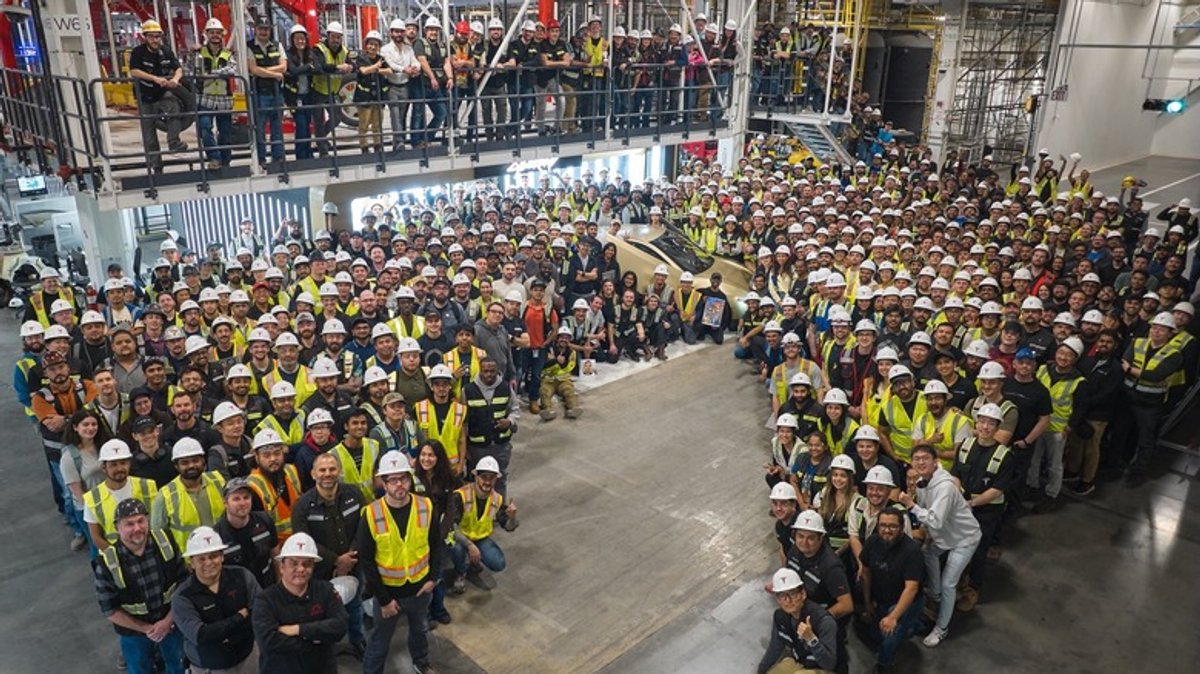
The big announcement accompanying the results: Cybercab production has officially begun. Elon Musk posted a 38-second video on X with the caption "Cybercab production has started." It shows the vehicle leaving the assembly line and driving itself, without a driver, followed by a clip of several golden units driving in formation.
The first unit had already rolled off the Gigafactory Texas line in February 2026, and the group had announced the official start of production in April. Ramp-up is scheduled between the third and fourth quarters of 2026, with mass deployment and retail sales to individuals starting in 2027.
📋 Fiche technique
At what price and for whom?
The Cybercab is primarily designed for the robotaxi service, driverless, with two passenger seats and zero manual controls—no steering wheel, no pedals. For retail sales to individuals, the target price is below $30,000, and possibly around $25,000. That's significantly less than most current Teslas. Elon Musk had announced this at the October 2024 unveiling, with a public market launch planned for 2027.
Commercial rollout advances in Austin
Tesla launched its robotaxi service in Austin in June 2025, using Model Y vehicles equipped with its autonomous driving software. Since then, the service has expanded to several other U.S. cities: Orlando, Tampa, Miami, Dallas, Houston, and San Fr

Written by
Sophie RenardSpecialist luxe, premium, sportive, sport auto, allemandes, reglementation, assurance, prix, ventes
Spécialiste du segment premium et luxe, Sophie couvre l'actualité des marques prestigieuses depuis 12 ans. Ancienne attachée de presse pour un cons...
View all articles (15)Read More
•Tesla Cybercab: Production Begins, Price Confirmed Under $30,000
•Tesla Semi: Mass Production in 2026 with 800 kW Charging
•Tesla Model Y 2026: 7-Seat and Model Y L Arrive in Europe
•Tesla Drops Autopilot in California to Keep Selling Cars
•Tesla Cybertruck AWD at $59,990: Most Accessible Version Finally Here
•Tesla Integrates Grok, Urban Tunnels Revolutionize Mobility
•Tesla Autopilot: 8 Billion Miles, $243M Verdict
•Tesla Semi 2026: Mass Production, Specs & $165M Subsidies